Comparison of Paint Application Methods: How to Choose a Technology for a Specific Task
The method of applying paint and coating material is part of the coating's technological system. The chosen equipment and operating mode determine painting productivity, paint consumption, thickness uniformity, surface appearance, and consistency of results from product to product.
For industrial painting of metal surfaces, the most common methods are pneumatic spraying, airless application, and electrostatic painting. For small volumes and repair work, manual spray guns of various classes are used.
At the same time, the choice of equipment cannot be reduced to a simple comparison of cost or productivity. A quality spray gun is not always the best solution, airless technology is not always more rational than pneumatic, and the advantages of electrostatics manifest only under a certain organization of production.
In practice, the technologist selects the application method taking into account several factors:
type of paint and coating material → area and geometry of the product → required thickness → appearance requirements → production volume → permissible consumption → application conditions.
Therefore, the same coating system for different objects may be applied by different methods.
Problem Statement and Why This Matters
Equipment Price Does Not Determine Coating Quality
When choosing a spray gun, there is often a desire to reduce initial costs and purchase the most affordable equipment.
For small volumes, this may be quite rational. But for regular industrial painting, what matters is no longer the price of the tool itself, but the cost of obtaining a stable coating.
If the equipment does not form a stable fan, requires constant adjustment, or does not provide uniform material supply, this can lead to:
- increased paint consumption;
- variations in coating thickness;
- appearance of runs and unpainted areas;
- increased painting time;
- additional operations to correct defects;
- differences between batches of products.
Therefore, professional equipment should be evaluated not by its purchase price, but by its influence on the overall cost of the painting process.
An Expensive Spray Gun Does Not Make an Operator a Technologist
Even quality equipment does not compensate for incorrect settings.
The result depends on the combination of:
- pressure;
- material flow rate;
- fan parameters;
- nozzle diameter;
- paint viscosity;
- distance to the surface;
- speed of gun movement;
- material and ambient temperature.
If these parameters are not coordinated with each other, the advantages of professional equipment may not be realized.
Therefore, a good spray gun is a tool for stable technology, not an independent guarantee of quality.
The Application Method Must Match the Paint Itself
Different industrial coatings have different rheological properties, solids content, and film formation requirements.
For example, a primer material intended to form a protective layer and a finish enamel with high appearance requirements may impose different demands on atomization.
Therefore, when choosing equipment, it is necessary to take into account the recommendations of the specific paint manufacturer, not just the material category.
Solution Options
Quality Pneumatic Spray Gun
Pneumatic spraying allows a well-controlled fan to be obtained and material to be distributed evenly over the surface.
Quality equipment is especially justified where repeatability of result and coating appearance are important.
This is relevant for:
- finish painting;
- commercial transport;
- special-purpose machinery;
- equipment;
- metal parts;
- products of complex shape;
- series production where the same result must be obtained from batch to batch.
A professional spray gun provides more stable operation and allows the operator to control material distribution more precisely.
This is especially noticeable when using expensive paints. If the material has a high cost, overspray due to an incorrect fan becomes a direct economic loss.
At the same time, a quality spray gun requires proper adjustment. Equipment designed for one range of materials should not be automatically used with another paint without checking operating parameters.
Cheap Spray Gun
A budget spray gun is not automatically a bad solution.
If it is necessary to periodically paint small products or perform repair work, purchasing expensive equipment may be unjustified.
A budget tool may be rational for:
- small volumes;
- one-off production;
- local repair;
- painting individual parts;
- irregular use.
Problems appear when inexpensive equipment is used as a permanent production tool.
In this case, even small shortcomings — unstable fan, uneven supply, more complex adjustment — begin to repeat many times.
For a single part, this may be practically unnoticeable. For hundreds of products, the same problem turns into systematic material overspending and increased labor costs.
Therefore, a budget and a professional spray gun must be compared by the indicator:
cost of quality-painted area, not just by the cost of the equipment itself.
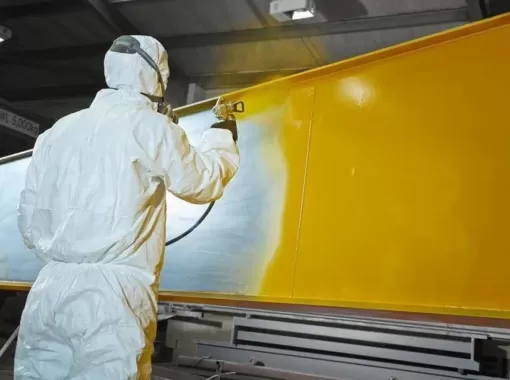
Airless Application
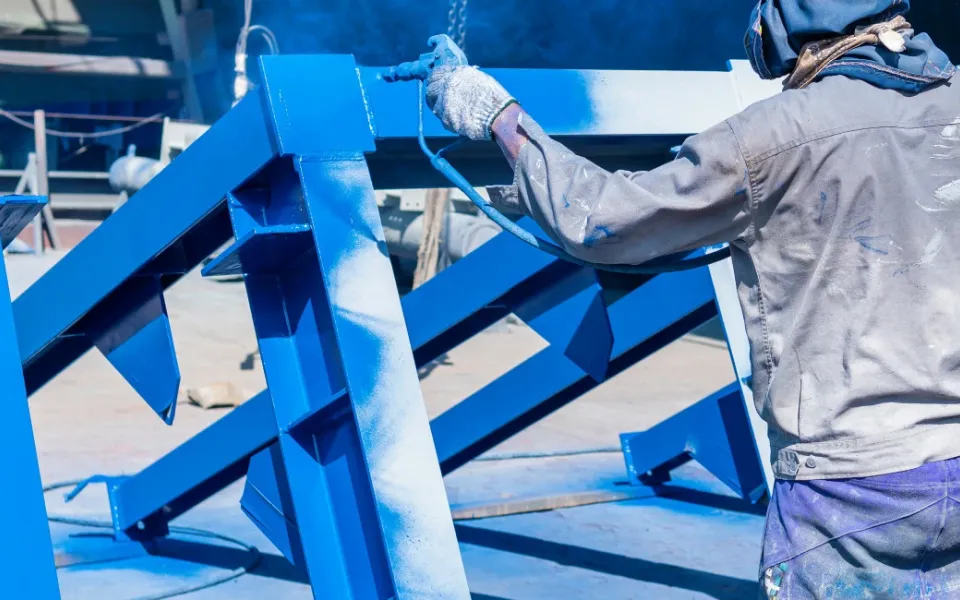
Airless technology differs fundamentally from pneumatic spraying in the way the fan is formed.
The paint is supplied to the nozzle under high pressure, and atomization occurs as the material exits through a small nozzle opening.
The main advantage of the technology is high productivity and the ability to apply a significant amount of material in a short time.
This is especially important when painting:
- large metal structures;
- heavy equipment;
- tanks and vessels;
- special-purpose machinery;
- agricultural machines;
- railway transport;
- large metal surfaces.
Where Airless Technology Wins
Suppose it is necessary to apply a protective system to a large metal structure.
With pneumatic spraying, the operator has to make a large number of passes, and part of the material is lost as excess aerosol.
Airless technology allows the required coating thickness to be formed faster and productivity to be significantly increased.
The advantage is especially noticeable when applying materials with high solids content and systems requiring a relatively large coating thickness.
However, this does not mean that airless application is always more economical.
For small parts, complex geometry, or high decorative requirements, the productivity advantages may be insignificant.
Quality Pneumatic Spray Gun or Airless System?
This is one of the most practical questions when organizing industrial painting.
Pneumatic spraying is more rational if:
- the product area is relatively small;
- appearance is important;
- a thin and controlled layer is required;
- the product has complex geometry;
- production volume is moderate;
- the operator must precisely control the fan.
Airless application is preferable if:
- the surface area is large;
- high productivity is required;
- a significant thickness must be obtained quickly;
- a protective system is used;
- large structures or machinery are being painted;
- the cost of working time is significant.
At the same time, these technologies can complement each other on the same object.
For example, the main area of a large metal structure can be applied by airless method, while individual zones, edges, or areas of complex geometry can be applied by another method.
Electrostatic Application
Electrostatic painting differs from traditional spraying in the principle of material transfer.
Paint particles are given an electric charge, and the metal part being painted is grounded. An electric field arises that promotes the movement of charged particles toward the surface.
The main advantage of the technology is the ability to increase material transfer efficiency.
This is especially interesting for series production, where a large number of identical metal products are painted.
The economic effect can be formed through:
- reduced material losses;
- high repeatability;
- process automation;
- high productivity;
- coating thickness stability.
Where Electrostatics Is Truly Justified
Electrostatic technology is especially effective when production has:
- a large number of identical parts;
- stable product geometry;
- an organized painting area;
- the possibility of quality grounding;
- equipment to maintain stable process parameters.
For example, series painting of metal housings, equipment elements, or other repeating parts can create conditions under which investment in an electrostatic system is economically justified.
Limitations of the Electrostatic Method
Electrostatics is not a universal technology.
Complex product geometry can lead to uneven material distribution. On internal surfaces, in deep recesses, and in shielded areas, the effect of electrostatic attraction may be less pronounced.
Therefore, before choosing a technology, it is necessary to analyze the product geometry.
If the main task is painting a large structure with many hard-to-reach zones, the advantage of electrostatics may be significantly lower than when painting a large number of relatively simple parts.
Comparison of Methods
| Method | Strength | Limitations | Optimal Task |
|---|---|---|---|
| Cheap spray gun | Low equipment cost | Less stability and productivity | Small volumes, repair |
| Quality pneumatic | Fan control and surface quality | Higher cost, relatively low productivity on large areas | Finish painting, machinery, parts |
| Airless application | High productivity, fast thickness build-up | Demanding on adjustment and work technique | Large surfaces, protective systems |
| Electrostatics | High transfer efficiency, automation | Requirements for geometry, grounding, and production organization | Series painting of metal parts |
At the same time, this comparison cannot be considered absolute. The final material consumption, productivity, and quality depend on the specific paint, equipment, and working conditions.
Choosing a Method Depending on the Situation
Painting a Small Batch of Parts
If a small number of products need to be painted periodically, a complex automated system may be economically unjustified.
A quality pneumatic spray gun will provide the necessary quality without significant capital costs.
For occasional work, budget equipment may also be sufficient if appearance and repeatability requirements are not high.
Series Painting of Parts
With a large number of identical products, the situation changes.
Here, process stability comes to the fore, so a quality spray gun or an automated electrostatic system may be significantly more advantageous than cheap equipment.
Even a small paint overspend, multiplied by thousands of products, can exceed the difference in equipment cost.
Painting Large Special-Purpose Machinery
For large machinery, both surface area and geometry complexity must be taken into account simultaneously.
Airless application allows a protective layer to be formed quickly on large areas.
When applying finish enamel with increased appearance requirements, it may be advisable to use quality pneumatic or combined spraying.
In practice, a combination of methods may be technologically justified.
Painting Metal Structures
For large metal structures, productivity usually becomes the priority.
If the main task is anticorrosion protection and forming the specified thickness, airless application is often the most rational.
At the same time, welded joints, edges, and other zones may require additional treatment as part of the overall painting technology.
Finish Decorative Painting
When the main criterion is coating appearance, the quality of fan formation becomes especially important.
In such tasks, a professional pneumatic spray gun may have an advantage over technology focused primarily on maximum productivity.
What Matters Is Not Equipment Cost but the Cost of the Technological Result
When choosing an application method, it is a mistake to compare only initial investments.
It is more correct to consider:
equipment cost + paint consumption + productivity + labor costs + number of defects + changeover time + repainting cost.
Suppose a cheap spray gun costs several times less than a professional one.
If, at the same time, it increases paint consumption by several percent, reduces work speed, and leads to the need to correct some defects, the savings may disappear already during operation.
On the other hand, purchasing an expensive electrostatic line for a small production volume will also not be rational.
Therefore, the optimal technology is determined by the cost of obtaining the required result, not by the cost of equipment as a separate asset.
Results and Conclusions
Each application method has its own area of effective use.
A budget spray gun is justified for small volumes and irregular work.
A quality pneumatic spray gun is suitable for tasks where fan control, appearance, and coating repeatability are important.
Airless painting is effective for large areas, high productivity, and the need to quickly form a protective layer of specified thickness.
Electrostatic application is most interesting for organized series production of metal products, where high material transfer efficiency and automation can provide an economic effect.
But none of these methods can be called universally best.
Equipment must be selected together with the paint, since the properties of the material determine the requirements for atomization, and the product geometry and production conditions determine the feasibility of a specific technology.
That is why, when developing an industrial painting system, it is necessary to evaluate not individual elements but the entire technological chain:
surface preparation → paint → equipment → application parameters → coating thickness → film formation conditions → quality control.
A correctly selected method allows not just faster paint application. It allows stable production of the required coating with predictable material consumption and specified performance characteristics.
This is exactly what should be the main criterion for choosing an industrial painting technology.