Pipeline in Industrial Operation
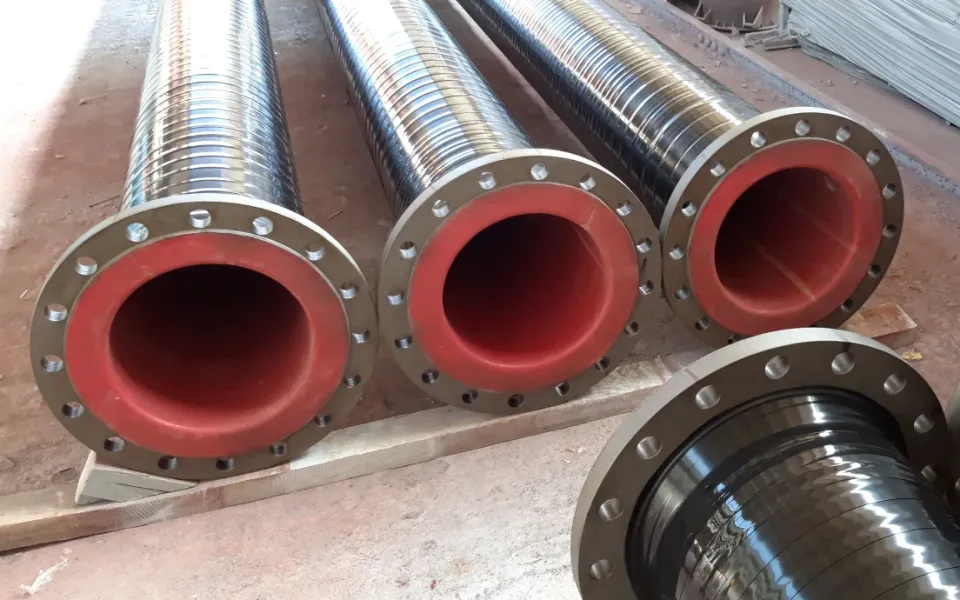
A pipeline in industrial operation is an extended metal structure that may be exposed to moisture, atmospheric precipitation, temperature changes, industrial contaminants, and chemically active substances.
At the same time, the requirements for pipeline coating are determined not so much by its purpose as such, but by the specific operating conditions.
A cold water supply pipeline inside a production room, an external process communication line, a pipeline at an oil and gas facility, and a section of an industrial network with elevated temperature operate under fundamentally different conditions. Using the same paint and coating material (PCM) system for such objects without analyzing the operating environment can lead either to unjustified cost increases or to insufficient coating service life.
The main task of industrial pipeline painting is to form a stable protective system that maintains adhesion and coating integrity throughout the required service period.
Therefore, the selection of PCM should begin not with a specific enamel, but with an analysis of:
pipe material → surface condition → operating conditions → temperature → aggressiveness of the medium → service life requirements → application technology.
What Factors Determine the Choice of Coating
Operating Conditions
The first question when selecting a system is where and how the pipeline will be operated.
It is necessary to determine:
- whether the pipeline is indoors or outdoors;
- whether constant or periodic moisture is present;
- whether contact with atmospheric precipitation is possible;
- whether industrial gases and vapors are present;
- whether contact with oils, petroleum products, or chemicals is possible;
- whether the surface is subject to mechanical impacts;
- what the working and maximum temperatures are;
- whether regular maintenance is planned.
It is the combination of these factors that determines the requirements for the coating system.
For example, for a dry room there is no need to automatically use a system designed for heavy atmospheric or chemical loading. But if the same pipeline goes outdoors and is constantly exposed to wetting, the coating requirements increase significantly.
External Surface of the Pipeline
For most steel pipelines located outdoors, the main task of the coating is to protect the metal from atmospheric corrosion.
The coating must prevent moisture penetration while maintaining integrity under exposure to:
- rain and snow;
- wetting and drying cycles;
- solar radiation;
- temperature changes;
- industrial dust and contaminants.
Depending on the facility requirements, a multilayer system may be used:
surface preparation → anticorrosion primer → finish enamel.
The primer layer forms the basis of the system and provides the necessary characteristics at the boundary with the metal substrate.
The finish coating protects the lower layers from external exposure and forms the required decorative characteristics.
For less loaded conditions, a primer-enamel may be used if its characteristics meet the facility requirements.
Pipelines Inside Production Premises
Operation indoors does not automatically mean the absence of a corrosion load.
In production shops, the metal surface may be exposed to:
- elevated humidity;
- condensate;
- process vapors;
- aerosols;
- oils;
- chemical contaminants;
- elevated temperature.
Therefore, when selecting a coating, it is necessary to assess the actual environment, not just the presence of walls and a roof.
For example, a pipeline in a dry heated room and a pipeline in the area of process equipment where condensate constantly forms and aggressive vapors are present require different approaches.
Pipelines in a Chemically Aggressive Environment
At oil and gas and chemical enterprises, the external surface of a pipeline may be exposed to chemically active substances.
Here it is not enough to focus only on the weather resistance indicator.
It is necessary to take into account:
- the specific composition of the aggressive medium;
- the concentration of the substance;
- temperature;
- duration of exposure;
- frequency of contact;
- presence of condensate.
The chemical resistance of a coating is always related to a specific medium.
A material resistant to one substance at a certain temperature will not necessarily demonstrate similar behavior when in contact with another medium.
Therefore, for critical facilities, the system should be selected based on actual operating conditions and the technical characteristics of the specific PCM.
Operating Temperature
Temperature is one of the parameters that cannot be ignored when choosing a coating for a pipeline.
Elevated temperature affects the aging rate of the polymer film and can change its mechanical and protective characteristics.
It is especially important to distinguish:
- ambient temperature;
- pipe surface temperature;
- constant working temperature;
- short-term temperature peaks.
The pipeline surface may heat up more than the ambient air, for example when transporting a hot medium or under exposure to solar radiation.
Therefore, when choosing a system, it is necessary to focus not only on the average ambient temperature, but on the actual temperature regime of the surface.
If the coating is not designed for the corresponding temperature, increasing its thickness or using a more expensive finish enamel will not solve the problem.
Internal Surface of the Pipeline
Internal painting is a separate technological task.
In this case, the coating directly contacts the transported medium, so the requirements are determined not by atmospheric exposure but by the properties of the product inside the pipeline.
It is necessary to take into account:
- composition of the transported medium;
- temperature;
- pressure and flow regime;
- chemical activity;
- abrasiveness;
- duration of contact with the coating.
For the internal surface, the same PCM used outside cannot be automatically used.
It is especially important to take into account the possibility of contact between the coating and the transported product and the suitability of the material for such contact.
Pipeline Surface Preparation
Why the Problem Often Starts Here
Even a correctly selected system may fail prematurely if the metal substrate is not prepared well enough.
Before painting, the surface may contain:
- mill scale;
- rust;
- oils;
- salts;
- dust;
- remnants of old coating;
- welding products.
If contamination or a loose corrosion layer remains between the metal and the primer layer, the adhesion of the coating decreases.
Under subsequent exposure to moisture, corrosion can develop under the film.
Therefore, surface preparation is part of the anticorrosion protection system itself.
New Pipelines
For new metal, it is necessary to assess the surface condition after manufacturing, transportation, and installation.
Particular attention is paid to removing:
- rolling mill scale;
- traces of oil and preservative compounds;
- contaminants after transportation;
- welding products.
After installation, a separate problem arises in areas with welded joints.
Repair Painting
During repair, it is necessary to evaluate not only the metal but also the existing coating.
Before applying a new system, determine:
- the degree of destruction of the old paint coating;
- the presence of peeling areas;
- the spread of corrosion;
- the adhesion of the remaining coating;
- the compatibility of the new system with the old coating.
If the old layer has lost adhesion, applying a new expensive enamel over it is technologically pointless.
The new system will be bonded to the weak old layer and may subsequently fail together with it.
Welded Joints, Edges, and Supports
A pipeline cannot be considered an ideally smooth cylindrical surface.
Welds, edges, flanges, fastenings, and supports create areas with complex geometry.
On them, it is more difficult to ensure uniform coating thickness.
Welded joints require special attention. After welding, the surface may contain metal spatter, scale, and other contaminants that must be removed before applying the protective system.
On sharp edges, the coating may also form differently than on flat areas. Therefore, the preparation and application technology must take into account the geometry of the structure.
Primer, Primer-Enamel, or Multilayer System?
Primer + Finish Enamel
A multilayer system allows functions to be distributed among individual materials.
The primer is responsible for the characteristics at the boundary with the metal and participates in anticorrosion protection.
The finish enamel forms the outer layer and provides the required weather resistance, appearance, and other operational properties.
This approach is especially rational for critical facilities where a long service life of the system must be ensured.
Primer-Enamel
Primer-enamel combines several functions in one material.
This may allow:
- reducing the number of technological operations;
- reducing painting time;
- simplifying repair work;
- lowering labor costs.
But the choice of primer-enamel must be based on the characteristics of the specific material.
By itself, reducing the number of layers does not mean increased efficiency.
If the facility operates in a heavy environment and requires a high service life, a multilayer system may be a more rational solution.
Choice of Application Method
Different application technologies are used for pipelines:
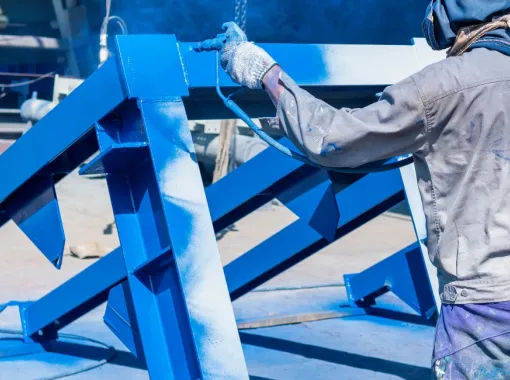
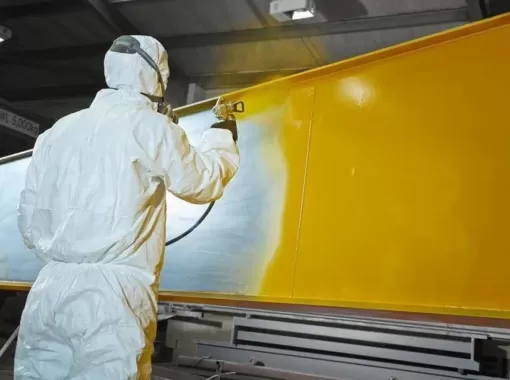
- airless spraying;
- pneumatic spraying;
- roller;
- brush.
When painting extended surfaces, airless spraying often has the advantage due to high productivity and the ability to quickly form the required thickness.
Pneumatic application may be preferable when there are high requirements for appearance.
Brush and roller are used for local areas, repairs, welded joints, and hard-to-reach zones.
In practice, the most rational solution may be a combination of several methods.
Control of Thickness and Coating Quality
For an anticorrosion system, it is important to control not only the uniformity of painting but also the actual dry film thickness.
Insufficient thickness can reduce the protective service life.
Excessive thickness is also not always an advantage: it increases material consumption and, in certain systems, can lead to technological defects.
Therefore, it is necessary to ensure the thickness specified by the technology of the specific system.
For critical pipelines, control may include:
surface preparation → substrate control → primer application → interlayer control → finish layer application → total thickness control → visual assessment of the coating.
Typical Mistakes in Pipeline Painting
Painting over Loosely Bonded Rust
The presence of a paint layer over rust does not yet mean the presence of anticorrosion protection.
If the corrosion layer is poorly bonded to the metal, it becomes the weak link of the system.
Ignoring Welded Seams
Treatment of the main surface does not compensate for insufficient preparation of welded joints.
Choosing PCM without Taking Temperature into Account
The coating must correspond to the actual surface temperature, not only the air temperature.
Lack of Thickness Control
A visually uniform coating may have significant thickness variations.
Incorrect System Selection for Repair Painting
A new enamel should not be applied over an old layer if that layer does not have the required adhesion.
Using One Solution for Different Sections
A pipeline system may include sections with different operating conditions. The same approach for the entire structure is not always technologically justified.
How to Select a Coating System for a Pipeline
Before choosing a PCM, it is advisable to form a technical specification at least by the following parameters:
| Parameter | What must be determined |
|---|---|
| Substrate | Steel grade and condition |
| Medium | Air, moisture, chemical vapors, process medium |
| Location | Indoors, outdoors, under a canopy, underground area |
| Temperature | Constant and maximum surface temperature |
| Corrosion load | Level and duration of exposure |
| Mechanical loads | Impacts, abrasion, vibration |
| Old coating | Condition and adhesion during repair |
| Required service life | Interval between repairs |
| Application | Airless, pneumatic, manual |
| Thickness | Required dry film thickness |
| Appearance | Color, gloss level, decorative requirements |
After this, a specific coating system can be selected, rather than a separate enamel outside the context of the facility.
Results and Conclusions
Pipeline coating is an engineering system for protecting the metal substrate, not just a decorative layer.
For external pipelines, the key characteristics are anticorrosion protection and weather resistance. For industrial facilities, chemical exposure must additionally be taken into account. For hot pipelines, the determining factor is surface temperature. For the internal surface of the pipe, requirements are formed by the properties of the transported medium.
Depending on operating conditions, different solutions may be used:
- primer + finish enamel — for multilayer protective systems with separation of functions between layers;
- primer-enamel — when it is necessary to combine protective and decorative functions and reduce the number of operations;
- specialized multilayer systems — for facilities with increased requirements for corrosion, chemical, temperature, or mechanical resistance.
At the same time, durability is determined not by an individual material.
It is formed by the entire technological chain:
surface preparation → selection of the PCM system → application technology → specified thickness → polymerization/drying → quality control → operating conditions.
Therefore, when selecting a coating for a pipeline, it is necessary to proceed not from the principle of “which paint is better,” but from the question:
which coating system will provide the required service life exactly under the conditions in which the specific pipeline will be operated?
This approach makes it possible to simultaneously ensure the required metal protection, control PCM consumption, and avoid both insufficient and unjustifiably complex coating systems.