Methods for Removing Paint and Varnish Coatings. Part 1: Mechanical
Surface preparation before applying new paint and varnish materials (PVM) is an integral and mandatory stage that determines the service life of the protective coating, decorative appearance, and application processability of the future coating. Up to 80% of premature failure and delamination cases in coating systems occur due to poor cleaning of the substrate from old paint layers, rust, and contaminants.
In this series of articles, we will focus in detail on methods for removing old paint and varnish coatings. We will examine the technology, applicability, and cost-effectiveness of each of the 5 main methods:
- mechanical
- abrasive blasting
- chemical
- thermal
- physical-optical methods
Today we will look at the first method.
Mechanical
The mechanical method for removing old paint and varnish coatings is based on the direct contact action of a cutting or striking tool edge on the polymer layer. In industrial practice, this method is regulated by the international standard ISO 8501-1 and is classified as hand and power tool cleaning (marked with the St index).
This method is fundamental for localized repair of metal structures, weld seam cleaning, automotive body repair, as well as in conditions where deploying a large abrasive blasting complex is technically impossible or economically unfeasible.
Classification of Tools Used
Tools for coating removal are divided into two main groups:
1. Hand tools:
- Putty knives, scrapers, shave hooks, and chisels made of hardened steel. Used to remove thick-film, cracked, and delaminated coatings. Operation is based on the principle of prying and chipping the polymer film.
- Hand wire brushes. Used for cleaning hard-to-reach areas (corners, internal radii) from loosely adhering paint.

2. Power hand tools:
- Pneumatic needle scalers (needle guns). The tool transfers impact energy to a bundle of independent steel needles. Upon impact with the surface, the needles effectively crush and chip hard, brittle, and multi-layer coatings. This method is indispensable for cleaning bolted joints, rivets, and uneven weld seams.

- Angle grinders with various types of abrasive discs.
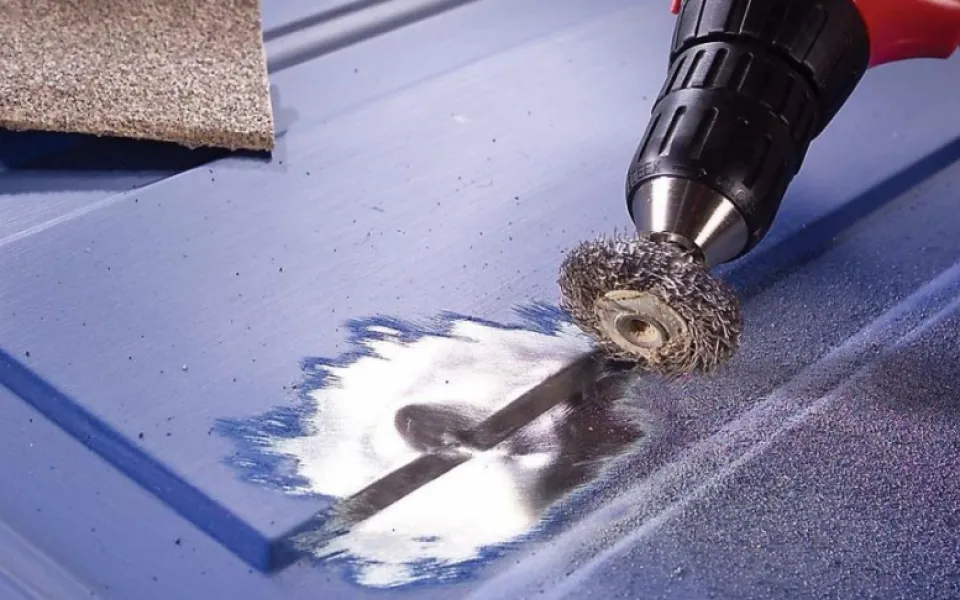
- Stiff wire wheel/cup brushes (effectively remove old coatings, but require strict adherence to RPM limits). With excessive pressure and high speed, twisted wire can "burnish" (polish) the metal.
Fiber discs (strip discs / "coral" discs). Made of porous nylon fiber impregnated with large silicon carbide crystals. Thanks to their open structure, they do not clog with elastic paint residue, do not overheat the substrate, and strip the coating without damaging the geometry of the base metal; this is one of the most effective mechanical methods for removing old coatings.

Disadvantages of Mechanical Cleaning Methods
Mechanical tools are effective against hard, brittle, and aged coatings. Modern elastic systems (thick-film polyurethanes, polyurea, bitumen-epoxy mastics) have high elasticity. They dampen (absorb) the impacts of pneumatic needles and scrapers, returning to their shape without destroying the polymer matrix.
Loading and clogging of the abrasive: when attempting to remove viscous or under-cured coatings mechanically, thermal energy from disc friction transfers into the paint. The polymer instantly softens, melts, and clogs the intergranular spaces of grinding discs or the gaps between the bristles of wire brushes. The tool loses its cutting ability within the first few minutes of operation. When stripping old alkyd, oil-based, or thermoplastic acrylic coatings with high-speed brushes, the temperature in the contact zone exceeds 100–120 °C. The melted polymer is not removed, but rather plastically deformed.
Substrate specifics: when cleaning soft metals (aluminum alloys, galvanized steel), steel brushes and abrasive discs are not recommended due to the risk of deforming thin metal and removing the protective zinc layer. Only specialized nylon or polymer attachments are used for such tasks.
When using hand and power tools, precautions must be taken to prevent excessive damage to the substrate, excessive roughness, or conversely, polishing of the surface, which will worsen the adhesion of future coating layers.
Productivity: the method is characterized by high labor costs. The average cleaning rate with power tools is 0.5 to 1.5 m²/hour per worker, making the method unprofitable for treating large areas.
Want to learn about other coating removal methods? Follow our blog for new articles.