Methods for Removing Paint and Varnish Coatings. Part 2: Abrasive Blasting
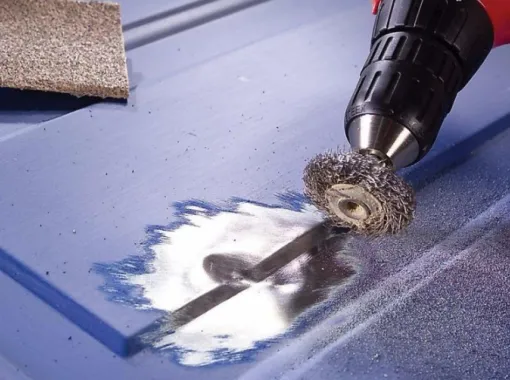
In the first article of the series, we discussed the mechanical method of removing paint and varnish coatings: hand and power tools, their applicability for localized repairs and cleaning weld seams, as well as their limitations — low productivity (0.5–1.5 m²/hour), abrasive loading on elastic coatings, and the risk of damaging soft metals.
Today we will examine the second method — abrasive blasting, which is regulated by the ISO 8501-1 standard (Sa marking) and is considered the primary industrial method for surface preparation prior to painting.
Abrasive Blasting
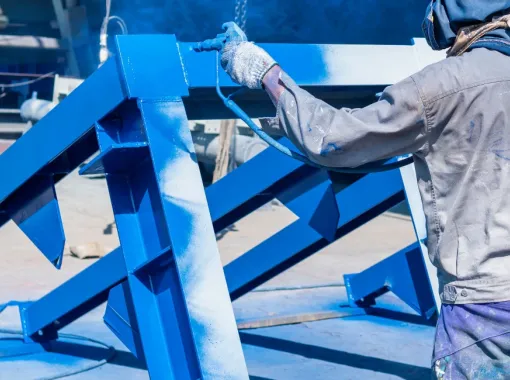
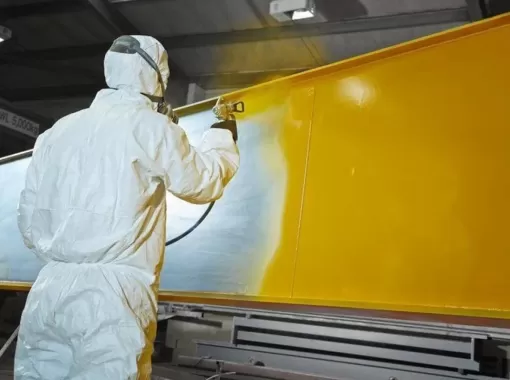
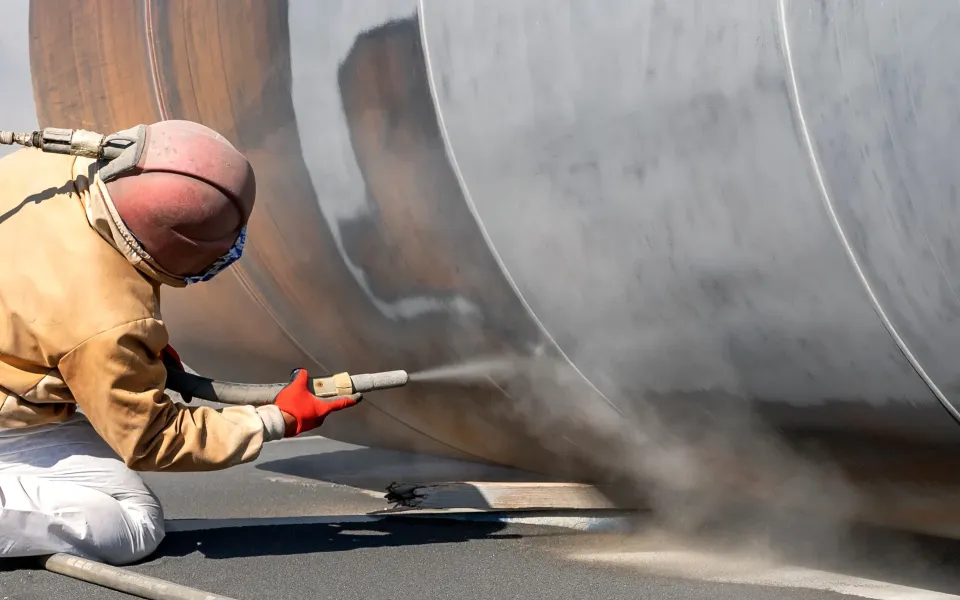
The abrasive blasting method (marked with the Sa index according to ISO 8501-1) is the most productive way to remove old paint and varnish coatings in the industrial sector. Its essence lies in a stream of solid particles (abrasive) accelerated by compressed air or centrifugal force, striking the surface at high speed. Unlike mechanical tools that scrape or impact locally, the abrasive acts like millions of micro-cutters, instantly chipping and shearing off the old polymer layer.
The main value of the method is that it does not just remove paint, but completely knocks out its remnants from micropores while simultaneously creating a surface profile that promotes strong adhesion between the applied coating and the substrate. Concurrently, corrosion products are thoroughly removed.
Types of Abrasives for Removing Paint and Varnish Coatings:
The speed of coating removal and the final condition of the metal directly depend on the specific media used for processing:
Metallic abrasives:
Angular grit (steel or cast iron). This is a reusable media for blast rooms and automatic wheel-blasting lines. Due to its sharp edges, angular grit works aggressively: it literally shears off heavy, tightly adhered multi-layer epoxy and polyurethane coatings with a thickness of over 300–500 µm. Spherical (cast) shot is less effective for removing thick-film coatings, though it handles thinner layers adequately.
Mineral abrasives:
Copper slag, silica sand, nickel slag, etc. These are the most popular single-use mineral abrasives for outdoor work (cleaning tanks, bridges, ship repair). They feature high hardness and sharp angles. Their cost is significantly lower than that of metallic abrasives.
Process Specifics: What Affects the Speed of Coating Removal
Removing paint with an abrasive has its own specifics compared to rust removal:
Compressed air pressure factor. To penetrate and strip off elastic or viscous paint (such as rubber mastics), high pressure is required — at least 7–8 bar. A soft coating dampens impacts; if the pressure is insufficient, abrasive particles will simply bounce off the paint. For brittle and old layers, the threshold can be lowered to 5–6 bar.
Grit size (fraction) selection. To remove old thick-film coating systems, a coarse fraction (1.5–2.5 mm) is used, capable of piercing the polymer thickness due to particle mass. If you need to remove a thin layer of tough paint, it is more effective to use a fine abrasive (0.2–1.0 mm) — the number of impacts per second per square centimeter increases, and the paint comes off faster.
Dust-Free Technologies: Wet Abrasive Blasting and Ultra-High Pressure Water
Dry sandblasting generates a massive amount of dust consisting of fine particles of destroyed polymer and the abrasive itself. For work in enclosed workshops or environmentally strict conditions, alternative methods are used:
Ultra-High Pressure Waterjetting (UHP Waterjetting). Paint is sheared off with pure water under ultra-high pressure — from 1,700 to 3,000 bar. This method is ideal for explosive and fire-hazardous zones (tank farms, refinery reservoirs), as it completely eliminates the risk of sparks.
Wet abrasive blasting (hydro-abrasive cleaning). Abrasive is mixed into the water stream. The water jacket suppresses 99% of the dust, cools the work area (preventing metal warping from overheating), and gently washes away sludge, leaving the surface ideally clean for priming.
Soft Blasting
When the task is to remove an old paint coating without altering the part's geometry, damaging the metal structure, or changing its surface roughness, standard hard abrasives are unsuitable. In such cases, soft blasting technologies are applied:
Cryogenic blasting (dry ice cleaning). Carbon dioxide (CO₂) pellets cooled to -79 °C are used as the abrasive. The method is unique in that it combines mechanical and thermal effects. Upon impact, the ice pellets instantly cool the paint, making it brittle, and then transition from a solid to a gaseous state (sublimate), expanding in volume up to 800 times. This micro-explosion literally lifts the coating layer off the substrate.
Main advantage: The method is completely non-abrasive — metal, chrome, glass, and even rubber seals remain untouched. Dry ice evaporates completely, leaving behind no secondary waste (only the stripped paint itself needs to be disposed of). The method is ideal for cleaning industrial molds, printing rollers, and industrial equipment parts without dismantling them.Organic (shell/pit) abrasives. This includes crushed walnut or almond shells, as well as fruit pits (such as apricot). The granules have low hardness compared to mineral sands, yet possess sufficient mass and sharp edges to scrape off coatings.
Area of application: used in aerospace manufacturing and automotive restoration for layer-by-layer removal of enamels from delicate alloys and composite materials. Walnut shells remove the top layer of paint without compromising the integrity of the underlying primer or the substrate itself.Plastic Media Blasting. Granules made of specialized thermosetting plastics of varying hardness. They work more gently than corundum or shot, yet faster than baking soda.
Area of application: allows rapid paint stripping from thin-walled aluminum structures, aircraft and helicopter skin panels, eliminating metal warping and changes in thickness.
Limitations of the Abrasive Blasting Method for Coating Removal
Risk of deforming thin metal. Intensive bombardment with coarse abrasive induces surface stresses in the metal. Thin-sheet parts (less than 2 mm) can warp from such processing — they lose their geometry and may become damaged.
Processing small parts is inefficient.
Ineffectiveness against hyper-elastic materials. Coatings such as liquid rubber or fresh polyurea are virtually impossible to remove with dry abrasive — they bounce back, wasting particle energy and leading to massive overconsumption of sand or grit.
Need for immediate protection. After abrasive blast cleaning, the metal surface begins to oxidize rapidly.
High equipment cost. The method requires substantial upfront investment: a high-output compressor, a blast pot, and air preparation systems (dryers) are required.